Detailed review
Google Cloud Conversational Agents (Dialogflow CX)
Google Cloud’s official Dialogflow documentation describes Dialogflow CX as a natural language understanding platform for designing a conversational user interface in apps, websites, devices or interactive voice response systems, with text or audio input and text or synthetic-speech responses. The official Conversational Agents pricing page describes two editions: Flows (also known as Dialogflow CX), for deterministic agents built with intents and flows, and Playbooks, for generative agents built with natural language instructions. Pricing is usage-based. Dialogflow ES is described as a separate, simpler agent type with its own pricing page.
Visit official website How we review
This visit button uses the official website. An affiliate_url placeholder is empty until a programme on Impact, PartnerStack or Awin is joined.
What it does (from official sources)
- Google Cloud documentation describes Dialogflow CX as a natural language understanding platform for designing and integrating a conversational user interface into a mobile app, web application, device, bot or interactive voice response system. Source: https://docs.cloud.google.com/dialogflow/docs · checked on 2026-11-18
- Official documentation says Dialogflow CX can analyse text or audio input and respond with text or synthetic speech. Source: https://docs.cloud.google.com/dialogflow/docs · checked on 2026-11-18
- The official Conversational Agents pricing page describes two editions: Flows (also known as Dialogflow CX) for deterministic agents built with intents and flows using NLU, and Playbooks for generative agents built with natural language instructions and building blocks such as playbooks, data stores, generative fallbacks and generators. Source: https://cloud.google.com/products/conversational-agents/pricing · checked on 2026-11-18
- The same official pricing page says customers can leverage both generative AI and deterministic logic, and can combine techniques (for example calling a Flow from a Playbook), with billing depending on the features used in each turn. Source: https://cloud.google.com/products/conversational-agents/pricing · checked on 2026-11-18
- Design-time requests, such as navigating the visual builder, are stated as free of charge on the official pricing page. Source: https://cloud.google.com/products/conversational-agents/pricing · checked on 2026-11-18
Who it is for
Teams that want a Google Cloud platform for complex or hybrid deterministic and generative conversational agents, according to official Google Cloud documentation.
Google Cloud availability and data residency depend on Google Cloud regions. Confirm current regions and terms with Google Cloud.
Categories: Enterprise platforms, Customer support · Listing facts checked on 2026-11-18
Pros (from official pages, not a hands-on test)
- Official documentation describes Dialogflow CX as a platform for designing conversational interfaces in apps, websites, devices or IVR, with text or audio in and text or synthetic speech out. Source: https://docs.cloud.google.com/dialogflow/docs
- The official Conversational Agents pricing page describes both deterministic Flows (Dialogflow CX) and generative Playbooks, and says you can combine them. Source: https://cloud.google.com/products/conversational-agents/pricing
- Usage prices are publicly listed (per chat request or per voice second), and design-time requests are stated as free of charge. Source: https://cloud.google.com/products/conversational-agents/pricing
- Official trial credits for new users are published ($600 for Flows and $1,000 for Playbooks, expiring after 12 months). Source: https://cloud.google.com/products/conversational-agents/pricing
Cons or limits (from official pages, not a hands-on test)
- This is a Google Cloud usage-based product, not a simple self-serve chatbot widget with a flat monthly “Starter” card. You need a Google Cloud project and to understand request- or second-based billing. Source: https://cloud.google.com/products/conversational-agents/pricing
- Hybrid Flows + Playbooks billing officially depends on architecture: in some designs a whole conversation can be billed at the higher Playbooks rate. That is easy to misread if you only look at the Flows number. Source: https://cloud.google.com/products/conversational-agents/pricing
- Dialogflow ES is a separate agent type with a separate pricing page; this listing does not cover ES prices. Source: https://docs.cloud.google.com/dialogflow/docs
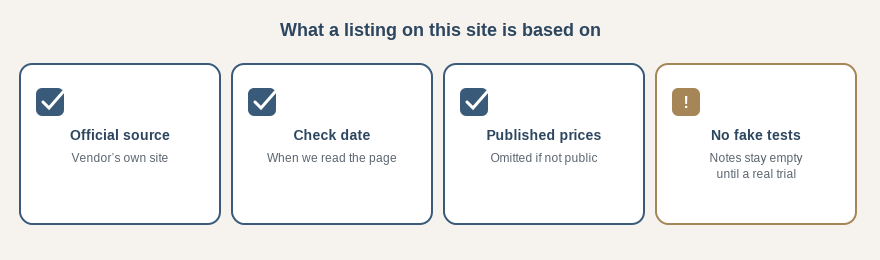
Pros and cons below are inferences from what the vendor publishes (for example a public price list, a free-plan limit, or a stated regional restriction). They are not results of a test we ran.
Pricing model (only if published officially)
The official Conversational Agents pricing page checked on 18 November 2026 states that customers pay for the aggregated count of requests (chat) or seconds of audio (voice). Published rates are: Flows (Dialogflow CX) chat $0.007 per count and voice $0.001 per second; Playbooks chat $0.012 per count and voice $0.002 per second. Data store index storage is listed with a free quota of 10 GiB per month and $5.00 per GiB of additional raw data per month. The page also states that new users automatically receive trial credits that expire after 12 months: $600 for Conversational Agents (Flows) and $1,000 for Conversational Agents (Playbooks). Dialogflow ES has a separate pricing page, and those figures are not repeated here. Confirm current prices at the official pricing page.
Source: https://cloud.google.com/products/conversational-agents/pricing · checked on 2026-11-18
These are Google Cloud list rates as published on the official pricing page and can change. Actual bills also depend on how many requests a conversation uses. A separately titled Google Cloud marketing page for Customer Experience Agent Studio was also observed; this listing quotes only the Conversational Agents / Dialogflow CX pricing page above and does not mix in other product prices.
Alternatives in this directory
These are other listed tools with an overlapping official job, not ranked substitutes. Read each review and the official site.
- Microsoft Copilot Studio — A Microsoft platform for creating and managing custom AI agents, workflows and apps, including chat or voice agents, with no-code and enterprise governance options. Official website
- Voiceflow — An enterprise platform for building and running AI customer-support agents over chat, phone and SMS. Official website
- Rasa — A conversational AI platform for product and engineering teams to build, test and deploy customer-facing agents in a visual studio or in code, including self-managed deployment. Official website
- Botpress — An AI agent platform for customer support, with a visual studio, optional helpdesk, and conversation-based pricing. Official website
Best-for verdict
If you are already on Google Cloud and need a documented, usage-priced platform for complex or hybrid agents, Conversational Agents / Dialogflow CX belongs on the shortlist. It is less approachable than a no-code website builder if you only want a small FAQ widget. This is not a hands-on test and not a paid ranking. Confirm details on the official site.
Hands-on testing notes
To be filled after hands-on test.
This directory does not claim to have used the product until this box is filled in by a person after a real test.
Frequently asked questions
What are the official list rates?
On the official Conversational Agents pricing page checked on 18 November 2026: Flows (Dialogflow CX) chat $0.007 per count and voice $0.001 per second; Playbooks chat $0.012 per count and voice $0.002 per second. Confirm the live page.
Is Dialogflow CX the same as Conversational Agents?
The official pricing page describes Flows as “also known as Dialogflow CX.” Dialogflow ES remains a separate, simpler agent type.
Are there free trial credits?
The official pricing page says new users automatically receive credits that expire after 12 months: $600 for Flows and $1,000 for Playbooks.
Have you tested this product?
No. Testing notes remain “To be filled after hands-on test.”
Official pages used for this listing
These citation links always use the plain official URL, even after an affiliate visit button is added.